Tamim Ansary
One day in the summer of 1973, I found myself wondering how my experience of life would have been different if I had been born 40,000 years earlier. It wasn’t the first time such a question had popped into my head and it wouldn’t be the last; but in the summer of ’73, I was approaching my 25th birthday, and that date felt important. At the time, actuarial charts calculated the average life span of an American man to be 75 years. In a few months, therefore, a third of my life would be over. It felt like this next birthday would mark the end of one stage in my life and the beginning of another. The end of childhood and the beginning of adulthood. A dim perception stirred in my subconscious then, that after the second stage there would be a third stage. I’m in that stage now.
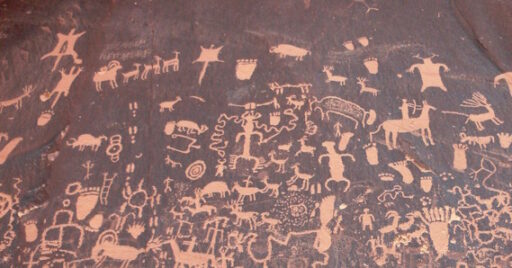
Science tells us that modern humans evolved at least a hundred thousand years ago. So the people putting those amazing paintings on the walls of caves in Europe and Asia 40,000 years ago were just as human as you and I: physically they were indistinguishable from us; their language was just as sophisticated , their emotions just as nuanced, their social relationships just as complex. So I coudn’t help but wonder: if I were living back then, would I have felt just like me now?
I remember the occasion vividly because a group of us had gone to eastern Oregon that weekend, to a place overlooking the Pelton Dam reservoir. There were nine or ten of us on the outing. Glenn and Claudia were there, as I recall. Viki was there … David? Margo, maybe? Teya…I don’t remember who all else but we were close, those people and I. We thought of ourselves as family, sort of.
The terrain around the Pelton Dam reservoir wasn’t a state park or anything. It was just undeveloped terrain, maybe BLM land. There was no paved road to the place. We drove down a dirt road to get there, two or three cars worth of us. There was no parking lot. We just stopped and got out, and there was the lake, a mighty reservoir created by the dam, and surrounding it was Eastern Oregon pine forest and grassland right to the horizon on every side. We were the only people there. No other cars, no other people to be seen. In 1973, spots like that weren’t hard to find. There were fewer people on Earth back then.
We’d come to Pelton Dam that day to take peyote. We sat next to the lake, and drank the water we’d soaked the peyote buttons in and then consumed the buttons themselves. They tasted foul, but we consumed as much as we could hold down without retching. That’s how it was done. When the peyote was gone, we just hung around together and chatted and enjoyed the perfect temperature, waiting for the effects to come on. They came on so subtly, we didn’t notice the transition. Some of us drifted away from the group, and then more of us drifted away, and then more of us until there was no “us”. The group had dissipated into the woods and shrublands. Each of us was alone and on our own now.
Around mid-afternoon, I found myself high on a slope overlooking the lake. At first, I thought the world was perfectly silent, but after I had been sitting there for a while, and my attention had calmed down to near-total stillness, I realized there were actually many threads of sound woven into this silence.
The air was in motion, and the faint breezes raised rustling sounds when they moved through the grass in open patches between the trees. If I had been here 40,000 years ago, my experience would have been the same. There were birds making their bird sounds, not continually but sporadically. They were letting out little bits of music as they went about their business. For them, it was just another normal day. And it was just a normal day for the insects too … beetles busy with their work…occasional crickets springing out of some shrub and making a dry whistle as they flew to other shrubs…
It struck me that the world surrounding me had a sort of harmonious singleness to it. All these little details—the breezes in the leaves, the crickets, the birds, my own breath, the lake—all of these details added up to some single picture. It struck me that no one else was seeing this picture. No one else ever had or ever would. The picture needed me there to exist at all. Some other day, after I was gone, someone else might come to this exact spot and a picture would exist here again, but it wouldn’t be this picture. It would be their picture, steeped in their sensibilities, threaded with their memories, situated within their life story…
Then another sound caught my attention. And when I say “caught”, I mean snagged like a hook snags a fish. The entire universe of sounds I had been noticing blurred into a single background against which this new sound stood out. The new sound was a series of taps. It went like this: Tap. Tap-tap. Tap. Tap-tap. Tap. Tap-tap.
This wasn’t just a sound. Read it aloud and you’ll see what I mean. This was a sound only another human would be making. Therefore, this was not just a sound. It was a message. In this case, of course, given the set-up, I knew that the human in question was one of my friends, but that’s not the important thing. What’s important is the way that sound instantly transformed the Big Picture that was the world in which I had been alone. Now I was in a universe that contained another human—and that made all the difference.
What I did then was pick up a stone, find a tree, and start tapping; except, I altered the rhythm. I said to this other human: Tap-tap Tap/tap/tap Tap-tap Tap/tap/tap
The other person responded: tap/tap tap/tap tap/tap
And so it went. I heard a message. I tapped a message. It was a reflex: the automatic human thing to do. We could perhaps have developed a system for sending messages with content if we’d kept at it, but for that moment, we both knew what message we were sending each other: I’m here. Are you there? I’m here. Are you there?”
And it felt to me like that was the fundamental first message we instinctively impart to other people. As soon as we detect another human on the scene, we start beaming out the message: HUMAN HERE. HUMAN THERE? HUMAN HERE! HUMAN THERE? We want to find each other.
As I write this, I’m reminded of the thing dogs invariably do. You see some guy walking his dog, let’s say a fluffy little thing the size of a rabbit—it’s trotting along obediently and happily behind its owner—then, suddenly, here comes a lady, with an English wolfhound 15 times its size—the dogs spot each other. Whoa! Instantly! For both those dogs, the whole cityscape and us humans within it blend into a blur of background against which the single most important thing can stand out: DOG HERE! DOG THERE? As soon as they’re released to follow their urges, those dogs run toward each other and do what dogs do, confront, circle, sniff butts, wag tails, whatever.
That fundamental message can get more sophisticated of course, but fundamentally “Hi, I’m Mike, I’m a Scorpio, what’s your sign?” is first of all that fundamental message: HUMAN HERE! HUMAN THERE?
Eventually that day, after drifting about, aware of one another in these woods, we drifted together again, me and my friends, drifted together until we formed, once again, a group. We built a fire then, and we heated up the things we had brought to eat, and we had a picnic, and we lounged about enjoying the beauty of that spot and chatting, and I probably told my friends about realizing that nature was full of noises, and someone probably said they saw a hawk from remarkably close, and someone else chimed in with some experience they’d had, and we all leaned in to listen to our various accounts of our various experiences that day.
And that’s when I got to thinking: what if this were 40,000 years ago and we were a group of humans living in some spot just like this, somewhere in the world? At some point in our typical day, we might very well have done some version of what our little group was doing now. We would have dispersed earlier on to hunt and gather and explore, and then at night we would have gathered with the rest of our tribal band to pool whatever food we’d obtained, and we’d tell one another what we’d done and seen. And as we chatted, we’d have been preparing our food: pounding it, peeling it, mashing it, cutting it up, roasting it–whatever food preparation involved at that time. Then we’d have gathered around the fire to eat our food and share our stories.
Of course our version of this basic activity was different than theirs would have been in superficial ways. I don’t know what they would have been wearing, but our garments would certainly have been different : they didn’t know how to make things like shirts and pants and shoes; these were all inventions, which came later. And if they built a fire, it would have been an elaborate task: they didn’t have matches. Their food would have been raw and unprocessed. They would not have had bread. Bread had not been invented yet.
But other parts, deeper parts, of this experience we were having in 1973 might not have been so different from the one our ancient human forebears would have had. For example, that sense of camaraderie we shared, sitting around our fire: that would probably have felt much the same. In 1973, when I looked at the people I was with that day, it stirred in me a warm sense of “these are my people.” I didn’t parse that feeling to identify what features we shared, what made us part of the same Our-People. I just felt it and I liked the feeling.
But I know that in my case, at least, that sense of belonging to some shared us-people was illusory. The little band of folks who were with me at Pelton Dam that day remain warmly remembered friends, but I haven’t seen most of them for years; some of them I haven’t seen for decades. If this were 40,000 years ago, the people around the fire sharing stories with me would have been people I had known from birth, would have seen every day of my life, and would know until the day I died. That’s one way, a big way, that human life is different now than it was 40,000 years ago.